






Diseases & Conditions
De Quervain's Tenosynovitis
De Quervain's tenosynovitis is a painful condition that occurs when tendons that control thumb movement become irritated inside the narrow tunnel they pass through to get from the wrist to the thumb.
This condition can cause pain and tenderness along the thumb side of the wrist. This is especially noticeable when you:
- Move the thumb
- Make a fist
- Grasp or grip something
- Turn the wrist
- Lift something with your arms in front of you and your thumbs pointed toward the ceiling, and movement occurs at the wrist (e.g., lifting a child)
Anatomy
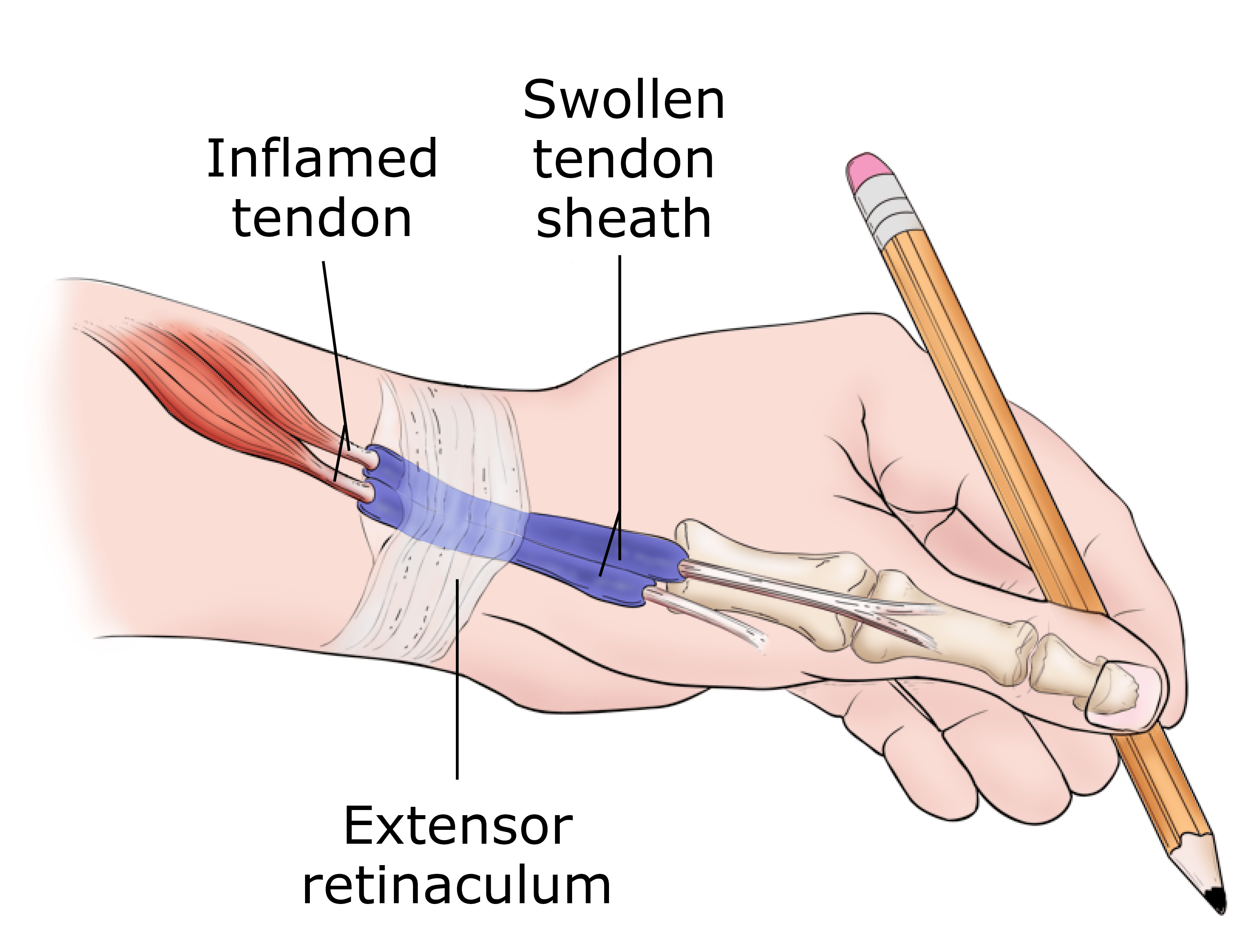
Tendons are rope-like structures that attach muscle to bone, allowing bones to move. On the thumb side of your wrist, tendons from two muscles run together through a narrow tunnel. These muscles are called:
- The abductor pollicis longus (APL), which helps move your thumb away from your hand
- The extensor pollicis brevis (EPB), which helps straighten your thumb
These tendons come from muscles in your forearm. The tendons are wrapped in a slippery, soft tissue layer called synovium, which provides nutrients and allows the tendons to slide smoothly. Together, tendons and their sheaths sit within a protective tunnel that keeps them close to the bone as they cross from the wrist into the hand.
In De Quervain's tenosynovitis, these tendons (APL and EPB) become irritated, and the sheath thickens. When this happens, the tendons no longer fit well or glide freely inside the tunnel. The result is increased friction and pain with certain thumb and wrist movements.
Causes of De Quervain's Tenosynovitis
The exact cause is not completely understood, though the condition can be worsened by movements of the wrist and thumb (e.g., typing, texting, or lifting). These are some other potential risk factors:
- It is associated with pregnancy and the postpartum period. People who develop symptoms after having a baby often notice them within 4 to 6 weeks.
- People with rheumatoid arthritis may be more susceptible to De Quervain's tenosynovitis.
- It is most common in people in their 40s and 50s.
- It affects more females than males.
Symptoms of De Quervain's Tenosynovitis
These are signs of De Quervain's tenosynovitis:
- You may feel pain on the thumb side of the wrist. This is the main symptom. The pain may appear either gradually or suddenly. It starts in the wrist and can travel up the forearm. The pain is usually worse when the hand and thumb are in use. This is especially true when you are forcefully grasping and/or lifting objects or twisting your wrist.
- You may see swelling over the thumb side of the wrist and/or a fluid-filled cyst in this area.
- You may feel a catching or snapping sensation when you move your thumb.
- Pain and swelling may make it difficult to move your thumb and wrist.
Diagnosing De Quervain's Tenosynovitis
To determine whether you have De Quervain's tenosynovitis:
- Your doctor will ask you about your medical history, including your symptoms, activities, and whether you have had any injuries to your hand or wrist in the past.
- Your doctor will do a physical examination and feel along the thumb side of your wrist, looking for pain and swelling.
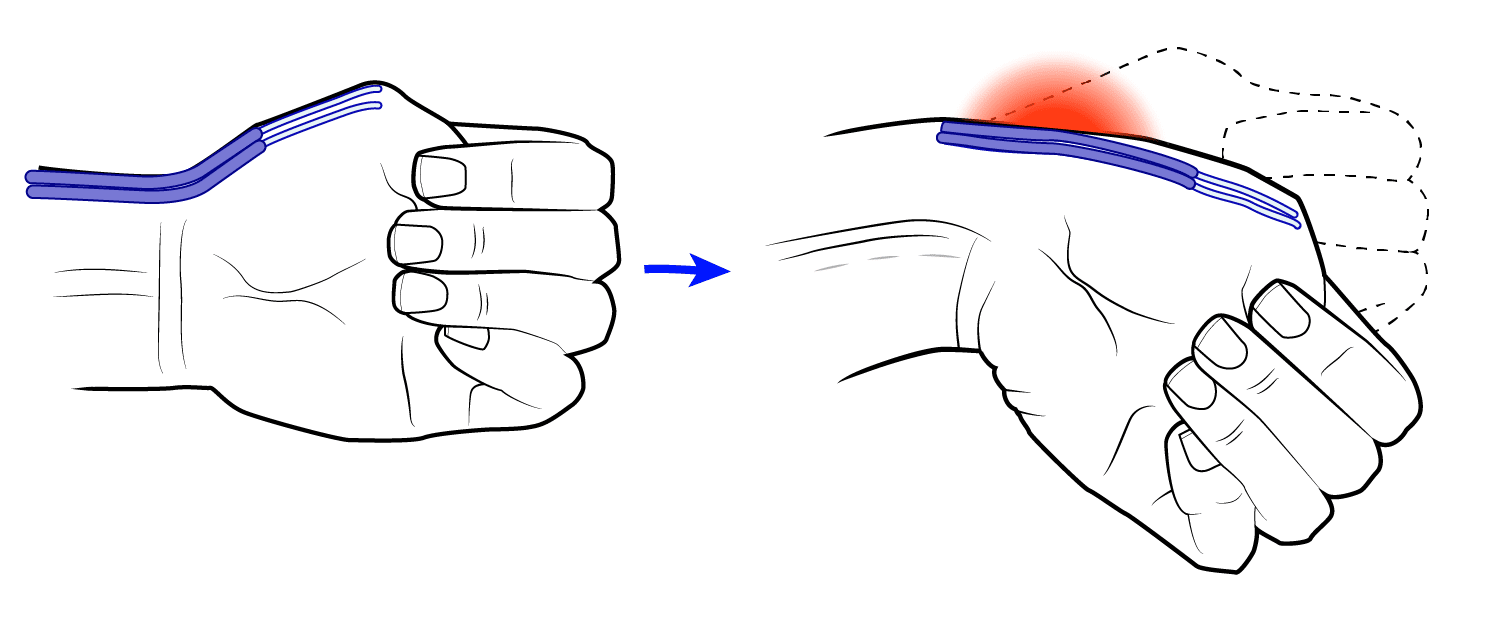
- You may be asked to perform the Finkelstein/Eichhoff test, which involves placing your thumb in your palm, grasping it with your other fingers, and bending your wrist toward your little finger. If you feel pain during the maneuver, it means you may have De Quervain's tenosynovitis.
- X-rays and ultrasounds are usually not needed. However, your doctor may order them if they are not sure of the diagnosis or need to rule out other conditions.
Treatment for De Quervain's Tenosynovitis
De Quervain's tenosynovitis is treated by reducing the swelling/irritation of the tendons and tendon sheath, thereby relieving the pain.
Nonsurgical Treatment
- Activity modification. Avoiding activities that cause pain and swelling may allow the symptoms to go away on their own.
- Splinting. A removeable splint that keeps the wrist straight and the thumb still in a comfortable position may improve pain, especially when worn at night.
- Icing. You can use a cold gel pack or bag of ice on the painful, swollen area every 4 to 6 hours for 15 minutes at a time. Do not put ice directly on your skin.
- Non-steroidal anti-inflammatory drugs (NSAIDs). Drugs like ibuprofen and naproxen can be taken by mouth or applied topically (e.g., a cream or gel). They may help reduce swelling and relieve pain.
- Corticosteroids. An injection of corticosteroids into the painful area can be effective in addressing the condition by reducing swelling and relieving pain.
Surgical Treatment
Surgery may be recommended if symptoms are severe or do not improve after 6 weeks of nonsurgical treatment.
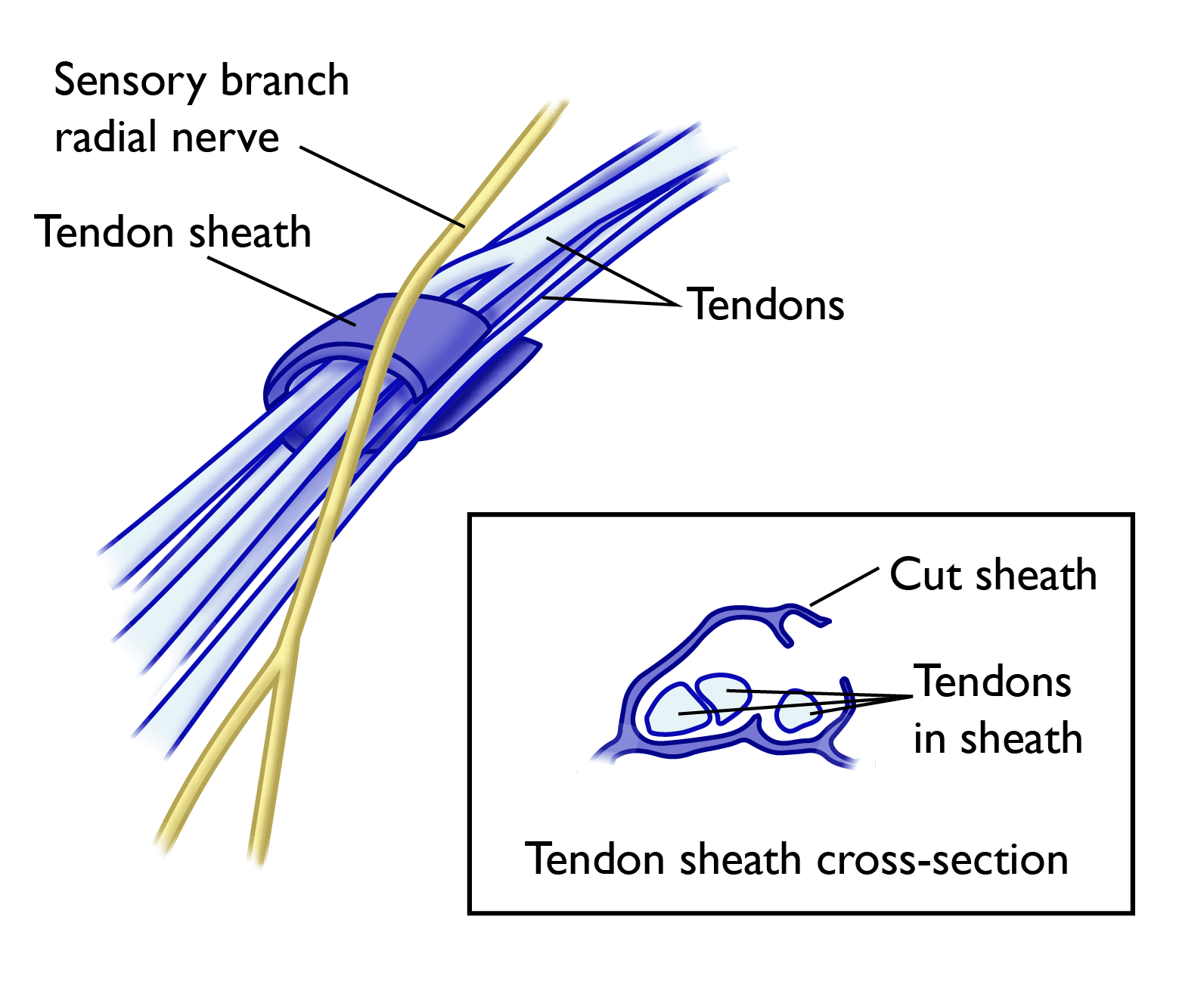
The goal of surgery is to release the tendon sheath to make more room for the irritated tendons. When done correctly, this can relieve the symptoms of De Quervain's tenosynovitis without affecting hand/wrist function.
During surgery:
- The surgeon first identifies and protects the nerves that live near the tendon sheath.
- The surgeon then releases the sheath in a way that avoids tendon instability.
- If there is excess tissue (tenosynovium) around the tendons, the surgeon will remove it.
- The incision is then closed, and a bandage (and sometimes a splint) is applied.
Regardless of the treatment, you can usually resume normal hand use once comfort and strength return. Your orthopaedic surgeon can advise you on the best treatment for your situation.
Recovery From De Quervain's Tenosynovitis
Most patients with De Quervain's tenosynovitis do very well and are ultimately relieved of their symptoms with nonsurgical and/or surgical treatment.
- Some patients can experience symptom relief with splinting or avoiding side-to-side motions of the wrist.
- Many patients experience symptom relief after a corticosteroid injection.
- For patients who need surgery, the majority experience improvement after the procedure.
Complications of surgery are rare. Patients with diabetes may be less successfully treated with injections and are more likely to have a surgical complication (infection, wound healing problems, etc.).
Most people with De Quervain's tenosynovitis recover well with appropriate treatment. The key is understanding your diagnosis, following your treatment plan, and avoiding or modifying activities that make the pain worse.
Contributed and/or Updated by
Peer-Reviewed by
AAOS does not endorse any treatments, procedures, products, or physicians referenced herein. This information is provided as an educational service and is not intended to serve as medical advice. Anyone seeking specific orthopaedic advice or assistance should consult his or her orthopaedic surgeon, or locate one in your area through the AAOS Find an Orthopaedist program on this website.