






Diseases & Conditions
Giant Cell Tumor of Bone
A giant cell tumor of bone is a type of benign (noncancerous) tumor that has a wide range of behaviors. These tumors typically grow at the ends of the body's long bones. Most often, they appear at the lower end of the femur (thighbone) or upper end of the tibia (shinbone), close to the knee joint.
Giant cell tumors usually occur in young adults, and are slightly more common in females. They are quite rare, occurring in only about one out of every one million people per year.
Although giant cell tumors are not cancerous, they are aggressive and can destroy the surrounding bone. Treatment for a giant cell tumor almost always involves surgery to remove the tumor and prevent damage to the bone near the affected joint.
Description
Giant cell tumors are named for the characteristic way they look when viewed under the microscope. When viewed microscopically, the tumors consist of many unusually large or "giant" cells. These cells are formed by the fusion of several individual cells into a single, larger cell.
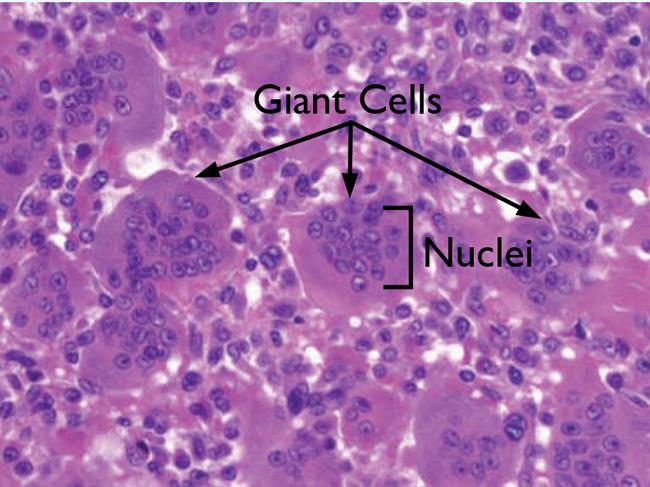
Many types of bone tumors and other conditions (including normal bone) contain giant cells. The diagnosis of giant cell tumor of bone is made when a large number of giant cells are seen among a background of other abnormal cells.
While most bone tumors occur in the flared area near the ends of the body's long bones (metaphysis), giant cell tumors occur almost exclusively in the end portion of the long bones (epiphysis), directly next to the joints.
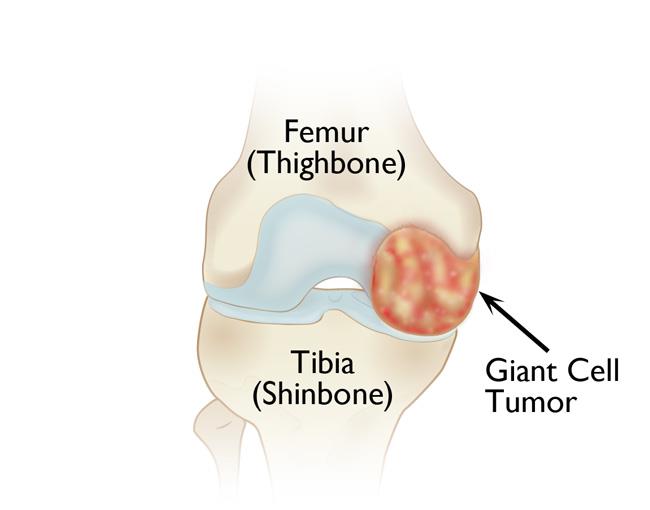
Most often, the tumors occur close to the knee joint — either in the lower end of the femur or the upper end of the tibia.
Other common locations include the:
- Wrist (lower end of the lower arm bone)
- Hip (upper end of the thighbone)
- Shoulder (upper end of the upper arm bone)
- Lower back (connection of the spine and pelvis)
In rare cases, a patient can have multiple giant cell tumors in different bones, a condition called multi-centric giant cell tumor of bone.
Most giant cell tumors occur in patients between 20 and 40 years of age. They do not typically occur in children or in adults older than 65 years of age. They occur slightly more often in females.
While giant cell tumors are typically benign (noncancerous), they can grow quickly and destroy bone close to a joint. In rare cases, a giant cell tumor may spread, or metastasize, to the lungs.
Cause
The cause of giant cell tumors is unknown. The tumors occur spontaneously. They are not known to be caused by trauma, environmental factors, or diet. Giant cell tumors of bone are not inherited.
The tumors may also be associated with overactivity of the parathyroid glands — a condition known as hyperparathyroidism. This is different than an isolated, single giant cell tumor of bone.
Symptoms
The most common symptom of a giant cell tumor is pain in the area of the tumor. The patient may also have pain with movement of the nearby joint. This pain usually increases with activity and decreases with rest.
The pain is usually mild at first, but gets worse over time as the tumor increases in size. Occasionally, the bone weakened by the tumor breaks and causes the sudden onset of severe pain.
Sometimes, the patient will have no pain at all, but will notice a mass or swollen area instead.
Doctor Examination
Your doctor will perform a thorough physical examination and use X-rays and other tests to diagnose a giant cell tumor.
Tests
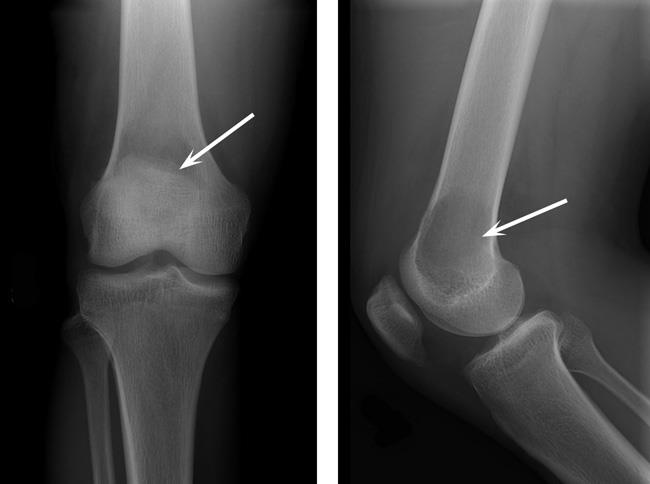
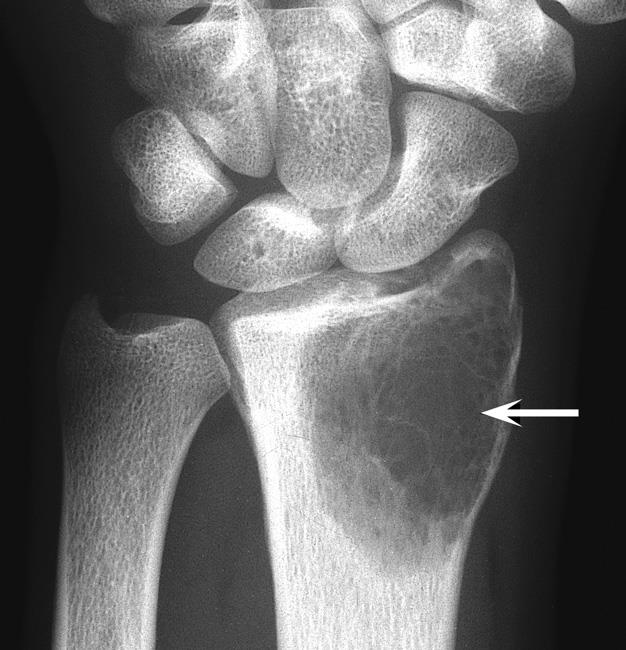
X-ray. X-rays provide images of dense structures, such as bone. Your doctor will order an X-ray to help confirm the diagnosis.
On X-ray, a giant cell tumor appears as a destructive (lytic) lesion next to a joint. Occasionally, the involved area of bone will be surrounded by a thin rim of white bone, which may be either complete or incomplete. There may also be expansion of the involved area of bone.
Other imaging studies. Your doctor may order a magnetic resonance imaging (MRI) scan or computerized tomography (CT) scan to better evaluate the tumor and the area surrounding it.
A CT scan or chest x-ray may also be done at the time of the initial diagnosis to determine if the tumor has spread to the lungs.
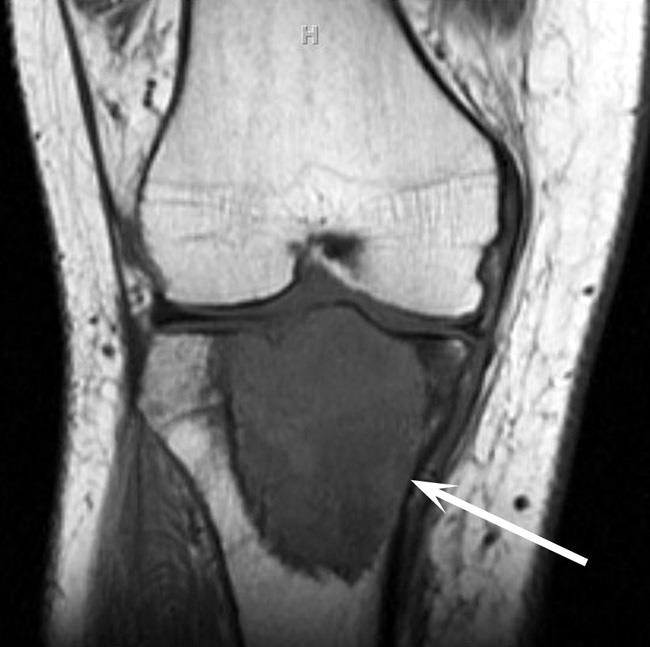
Bone scan. In some cases, your doctor may order a bone scan. During this test, a very small amount of radioactive dye is injected into the body intravenously. Giant cell tumors generally cause an increased uptake of the radioactive material and appear as a "hot spot" in the bone where the tumor is located.
Biopsy. A biopsy may be needed to confirm the diagnosis of a giant cell tumor. In a biopsy, a sample of tissue is taken from the tumor and examined under a microscope.
A biopsy can be performed under local anesthesia with a needle or as a small open operation.
Treatment
Without treatment, a giant cell tumor will continue to grow and destroy the surrounding bone, so treatment is always necessary. The goals of treatment are to:
- Remove the tumor
- Prevent damage to the bone
- Avoid recurrence of the tumor
Surgery is the preferred treatment for giant cell tumors; however, there are some cases in which a tumor cannot be removed safely or effectively through surgery. In this case, your doctor may recommend nonsurgical treatment.
Nonsurgical Treatment
Nonsurgical treatment may include:
Radiation. Radiation therapy may sometimes be used to shrink giant cell tumors in areas where surgery may be difficult to perform without damaging sensitive tissues — such as the spine. However, radiation therapy can result in the formation of cancer in some patients, so it is used only in rare cases.
Tumor embolization. During this procedure, specific arteries that supply blood to the tumor are blocked off. Without their supply of oxygen and nutrients, the tumor cells begin to die. Most often, embolization is performed prior to surgery, but it may also be used on its own in cases where surgery cannot be performed.
Medication. The FDA has recently approved the use of an injectable medication for the treatment of giant cell tumors. The medication works by targeting a special receptor on the giant cells. This decreases activity and slows down the breakdown of bone. However, because the tumor cells are located in between the giant cells, the tumor will recur after stopping the treatment. The medication is sometimes used in cases where surgery cannot be performed or for recurrent tumors.
Surgical Treatment
Surgery has proven to be the most effective treatment for giant cell tumors. Surgical treatment may include:
Curettage. Curettage is the surgical procedure most commonly used to treat giant cell tumors. In curettage, special instruments are used to scrape the tumor out of the bone.
Bone graft. After curettage, the cavity is filled with a bone graft to help stabilize the bone. A bone graft is bone that is taken from a donor (allograft) or from another bone in your own body (autograft) — most often the hip.
Your doctor may also use a bone cement mixture to fill the hole. Usually, additional chemicals, such as liquid nitrogen, hydrogen peroxide, or phenol, are placed inside the bone cavity to try to reduce the risk of recurrence. In some cases, an argon gas laser will be used to help reduce the risk of recurrence.
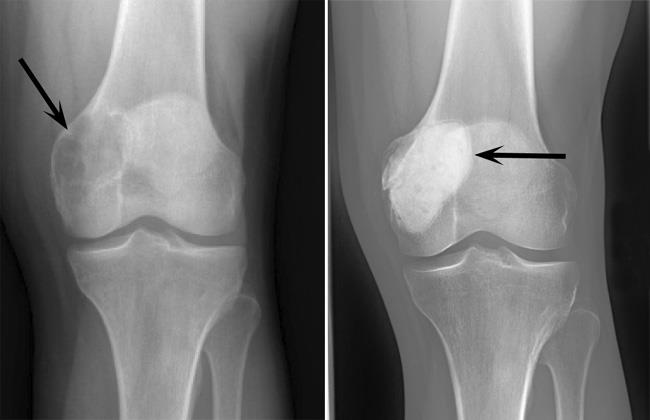
Other procedures. If a tumor has recurred or caused excessive bone or tissue damage, more complex surgical removal and reconstruction may be necessary.
Your doctor may use bone grafts, artificial joints, or a combination of these to reconstruct the bone, joint, or soft tissue sites. The goal is to restore the body part so that the patient can do his or her normal everyday activities.
In rare cases, a giant cell tumor may spread to the lungs. If the tumor spreads, surgical removal of the bone, as well as the affected area of the lung, is necessary. This will typically result in a cure.
Outcomes
Your outcome after treatment will depend on a number of factors, including:
- Your age
- The size and location of the tumor
- The method of treatment
Giant cell tumors can recur, so it is important to see your doctor for regular follow-up visits for a number of years after treatment. During these visits, your doctor will take X-rays of the involved site, as well as chest X-rays.
Last Reviewed
March 2021
Contributed and/or Updated by
Peer-Reviewed by
AAOS does not endorse any treatments, procedures, products, or physicians referenced herein. This information is provided as an educational service and is not intended to serve as medical advice. Anyone seeking specific orthopaedic advice or assistance should consult his or her orthopaedic surgeon, or locate one in your area through the AAOS Find an Orthopaedist program on this website.