






Staying Healthy
Motorcycle Safety
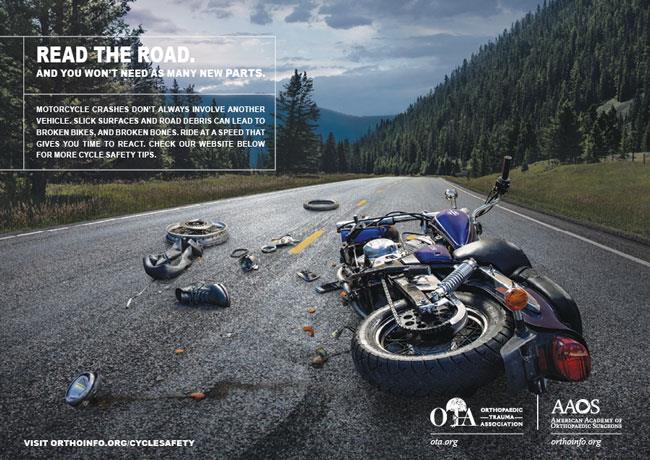
Read the Road. And You Won't Need as Many New Parts.
"Broken bikes cause broken bones," said Michael Suk, MD, of the Orthopaedic Trauma Association (OTA).
Orthopaedic surgeons are the doctors most often called upon to treat motorcycle injuries—including fractures to the leg, foot, arm, wrist and spine—but would rather "motorcycle drivers and passengers enjoy the ride without injury." Ride motorcycles at a safe speed, stay alert for unsafe driving conditions such as slick roads and road debris, and wear a helmet and other safety gear.
Regardless of age, motorcyclists who do not wear a helmet face a significantly higher risk of trauma in a crash—more severe head trauma—and a greater likelihood of death. The American Academy of Orthopaedic Surgeons (AAOS) endorses laws mandating helmet use by motorcycle drivers and passengers.
"Additionally, all motorcycle riders should learn how to safely operate a motorcycle, and regularly practice safe driving skills," said Dr. Suk.
Motorcycle Safety Statistics
The statistics below describe the incidence of motorcycle injuries and fatalities, and the prevalence of helmet use in the United States:
- Approximately 82,564 motorcyclists were injured and 6,335 were killed in traffic incidents in 2023, according to the National Highway Transportation Safety Administration (NHTSA).
- In 2023, motorcycles accounted for 15% of all traffic deaths, per the NHTSA.
- Motorcyclists are 9 times more likely to be injured in an accident than passenger vehicle occupants, according to an analysis by the Insurance Institute for Highway Safety.
- In 2023, the motorcycle death rate was nearly 28 times higher than the passenger car occupant death rate in traffic crashes.
- More than one-third of the motorcyclists killed in crashes the U.S. in 2023 were age 50 or older, according to the NHTSA.
- Among those ages 15 to 20, motorcycle-related deaths increased 44% from 2022 to 2023.
- Currently, 17 states and the District of Columbia have laws requiring all motorcyclists to wear a helmet, known as universal helmet laws, according to the Governor's Highway Safety Association (GHSA). Laws requiring only some motorcyclists to wear a helmet are in place in 30 states. There are no universal helmet requirements in Illinois, Iowa, and New Hampshire.
- The NHTSA reports that in states without universal helmet laws, based on known helmet use, 51% of motorcyclists killed in 2023 were not wearing helmets, compared to 10% in states with universal helmet laws.
- Overall motorcycle helmet use has increased in recent years: In 2023 (the most recent year data is available), 74% of motorcyclists wore DOT-compliant helmets. By comparison, 60% wore DOT-compliant helmets in 2012, according to the GHSA.
Tips for a Safer Ride
There are important steps you can take to help make your ride as safe as possible, including:
Take a motorcycle safety training course. A motorcycle safety training course provides the essential skills, knowledge and behavior to be a proficient motorcycle operative. Consider taking a refresher course or a specialty riding course, even if you are an experienced rider, to make safety a lifelong priority.
Always wear a helmet. According to the NHTSA, wearing a helmet is estimated to be 37% effective in preventing fatal injuries for motorcycle drivers and 41% effective for passengers, The "right" helmet has a "DOT" label to show that it meets U.S. Department of Transportation (DOT) safety standards, fits securely to the driver's head shape and side, protects the face, and has adequate ventilation to enhance cooling and reduce fogging.
Choose or purchase a motorcycle with anti-lock brakes. According to the Insurance Institute for Highway Safety, an antilock braking system (ABS) prevents the wheels from locking up when braking, reducing the risk of a fatal motorcycle crash by 22%.
Avoid driving in inclement weather. Slick roads, especially with snow, ice and debris, can make turning and braking more difficult.
Wear high visibility protective gear. According to NHTSA, high-visibility gear enables other drivers and motorcyclists to see you from a greater distance and in inclement driving conditions. Protective gear includes jackets, pants, boots and gloves.
Always follow traffic laws, drive the speed limit, and never drive after drinking. If you plan to drink alcohol, make plans ahead of time for another, sober motorcycle operator to drive your motorcycle, or leave your motorcycle somewhere safe.
Avoid driving "sport" and "super sport" motorcycle models. "Sport" motorcycles are light weight with high engine power and two times more deadly than cruiser and standard types of motorcycles, according to the NHTSA. "Supersport" models, built primarily for racetrack driving, are four times more deadly.
AAOS does not endorse any treatments, procedures, products, or physicians referenced herein. This information is provided as an educational service and is not intended to serve as medical advice. Anyone seeking specific orthopaedic advice or assistance should consult his or her orthopaedic surgeon, or locate one in your area through the AAOS Find an Orthopaedist program on this website.