






Diseases & Conditions
Hallux Rigidus (Stiff Big Toe)

Hallux rigidus (stiff big toe) occurs when a joint at the base of the big toe stiffens. It is the most common arthritic condition in the foot and can make walking painful and difficult. Hallux rigidus usually develops in adults between the ages of 30 and 60.
Anatomy of the Foot
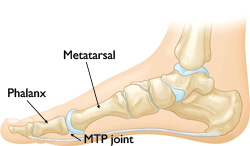
The big toe is made up of two joints past the level at which the toe takes off from the foot. The largest of the two is the metatarsophalangeal joint (MTP), where the first long bone of the foot (metatarsal) meets the first bone of the toe (phalanx). One function of this joint is to bend and grip the ground and to accommodate foot flexibility when walking.
Below the MTP joint, there are two small bones called sesamoids that help create a fixed pivot point to push off during walking.
Why Does Hallux Rigidus Develop?
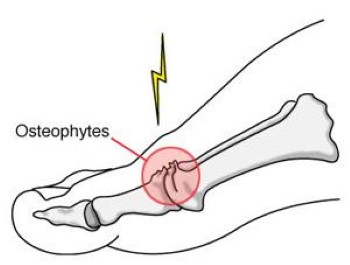
In the MTP joint, as in any joint, the ends of the bones are normally covered by smooth articular cartilage. If this cartilage is damaged, the bone ends can rub together. A bone spur, or overgrowth, may then develop on the top of the bone at the base of the big toe. This overgrowth can prevent the toe from bending as much as it needs to when we walk and can cause pain.
In later stages, all the cartilage is worn away, leaving bone-on-bone arthritis within the joint.
What Causes a Stiff Big Toe?
- Hallux rigidus may be the result of simple wear and tear or repeated traumatic injuries to the big toe that led to damage of the articular cartilage over time.
- In addition, poor foot alignment, such as a flatfoot or bunion, can create stress on the MTP joint and lead to hallux rigidus.
- There are also genetic factors that contribute to development of hallux rigidus.
Symptoms of a Stiff Big Toe
Symptoms of hallux rigidus can vary and may include one or more of the following:
- Pain in the big toe joint during walking or other activities. This pain usually occurs on the top of the joint, but it can also be deep inside the joint. You will notice difficulty pushing off, specifically during walking, or you may have pain over the top of your foot.
- Thickening around the joint, which may require you to make shoe wear modifications.
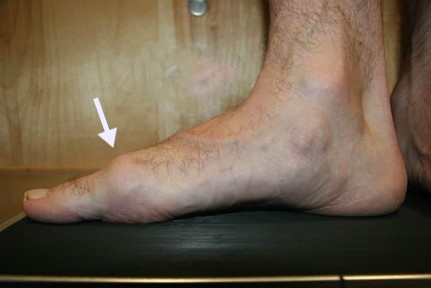
- A bump, like a bunion or callus, that develops on the top of the foot. There may be redness around the bump.
- Stiffness in the big toe and an inability to bend it up or down as well.
Diagnosing Hallux Rigidus
If you have difficulty bending your toe up and down or find that you are walking on the outside of your foot because of pain in the big toe, it's important to see your doctor and get a diagnosis.
Hallux rigidus can be easier to treat when the condition is recognized early. If you wait until you see a bony bump on the top of your foot, bone spurs will already have already developed, arthritis may already have set into the joint, and treating the condition may be more involved.
Physical Examination
- Your doctor will examine your foot and look for evidence of bone spurs.
- The doctor may move the big toe around to see how much motion is possible without causing pain. Moving the toe in various directions will also help determine whether the pain is deep or limited to the bump on the top of the toe joint. Knowing this will help your doctor decide which treatment to recommend.
Imaging Tests
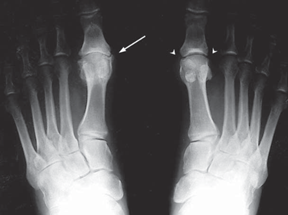
X-rays. Your doctor may choose to get X-rays of your foot. X-rays will show the location and size of any bone spurs, the degree of arthritis deep in the joint space, and the amount of cartilage loss.
Computed tomography (CT) scan. Doctors may occasionally order a CT scan to assess the alignment of the foot.
Magnetic resonance imaging (MRI) scan. Doctors may occasionally order an MRI to further assess the cartilage in the joint, fluid in the bone, and ligaments surrounding the joint. In some cases, an MRI can be used to help with surgical planning.
Treatment of a Stiff Big Toe
Nonsurgical Treatment
Over-the-counter medications. Your doctor may recommend pain relievers, such as oral or topical non-steroidal anti-inflammatory medicines (NSAIDs), to help relieve the pain and reduce swelling.
Ice. Applying ice packs to the toe may also temporarily help reduce inflammation and control your symptoms. Do not apply ice directly to the skin. Always use an ice pack or wrap the ice in a cloth or towel so you don't injure the skin by getting it too cold.
Footwear. Wearing a shoe with a large toe box will reduce the pressure on the top of the toe. High heels are not recommended.
Your doctor may suggest that you get a stiff-soled shoe with a rocker or roller bottom design. Often, a standard shoe with a stiff carbon fiber insert (called a Morton’s extension insert) or metal plate embedded in the sole of the shoe will relieve pain. These types of shoe modifications support the foot when you walk and reduce the amount of bend in the big toe, which reduces pain and inflammation.
Injections. A small corticosteroid injection into the MTP joint can be both diagnostic and therapeutic:
- It is sometimes used to clarify the diagnosis of hallux rigidus.
- It is sometimes used to relieve pain in patients who have not found relief with other nonsurgical treatments but are not good candidates for surgery.
A corticosteroid injection will not fix the problem and has risks, but it has the potential to provide pain relief for several months.
Surgical Treatment
If nonsurgical treatment methods are not effective, your doctor may recommend surgery.
Cheilectomy. Cheilectomy is usually recommended for patients who have mild or moderate hallux rigidus. It involves removing the bone spurs as well as a portion of the big toe bone, so that the toe has more room to bend.
The procedure can be done using either an open or minimally invasive approach with good success. Benefits of a minimally invasive approach include a smaller incision, which may help allow earlier walking and quicker recovery. However, an open approach allows the surgeon to see the entire joint more directly during the procedure.
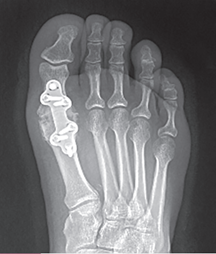
Arthrodesis. Fusing the bones together (arthrodesis) is often recommended when the damage to the big toe's cartilage is severe.
During arthrodesis, your doctor will remove the damaged cartilage and use pins, screws, or a plate to fix the joint in a permanent position. This will allow you to walk comfortably and possibly wear a low-heeled shoe.
Gradually, the bones will grow together, eliminating the toe joint completely. This means that you will not be able to bend the toe at all. However, arthrodesis is the most reliable way to reduce pain in patients with severe hallux rigidus, or in those who fail the cheilectomy.
Resection Arthroplasty. In elderly patients who are not very active, the surgeon may decide to remove part of the toe joint surface entirely. This procedure is not commonly used for patients who are very mobile.
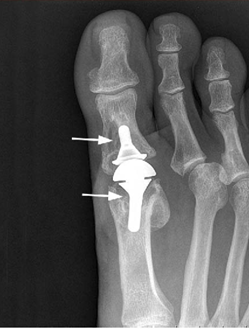
Arthroplasty. Older patients who place few functional demands on the feet may be candidates for joint replacement surgery (arthroplasty). During the procedure, your doctor will remove the MTP joint surfaces and implant an artificial joint. This procedure may relieve pain and preserve joint motion.
Hemiarthroplasty (partial joint replacement). In a hemiarthroplasty, only one side of the joint is replaced. This may be an option for patients with adequate cartilage on one side of the joint. However, it is not used as often as total joint replacement or arthrodesis.
Arthroplasty and hemiarthroplasty are less commonly used to treat hallux rigidus because of the potential need for repeat surgery if the implants loosen. Removing the implants during a future procedure can cause significant bone loss and may lead to functional problems.
Surgical Recovery
Pain management. Many types of medicines are available to help control pain, including opioids, nonsteroidal anti-inflammatory drugs (NSAIDs), and local anesthetics. Treating pain with medications can help you feel more comfortable while you recover.
Opioid medications can provide pain relief; however, their use has risks and complications. These medications can be addictive and potentially dangerous. It is therefore important to use opioids only as directed by your doctor.
Most commonly, opioids are prescribed for a very short time after surgery in low doses. A good rule of thumb is that these types of medications should be taken in the lowest doses possible, for the shortest amount of time possible. Tell your doctor if your pain has not begun to improve within a few days after surgery.
Most patients who undergo cheilectomy experience long-term relief. It is important, however, that you begin moving your toe early after surgery so that scar tissue does not cause the toe to stiffen again. The toe and surgical site may also remain swollen for several months. As a result, you will have to wear a wooden-soled sandal for at least 2 weeks after surgery. You can then transition to wearing a normal shoe that has enough room to accommodate the swelling.
Most patients who undergo arthrodesis will wear a splint or cast for the first 6 weeks after surgery. Once the splint or cast is removed, you will use crutches and wear either a boot, a stiff-soled shoe, or a shoe with a rocker bottom. Swelling can last 3 to 6 months.
Contributed and/or Updated by
Peer-Reviewed by
AAOS does not endorse any treatments, procedures, products, or physicians referenced herein. This information is provided as an educational service and is not intended to serve as medical advice. Anyone seeking specific orthopaedic advice or assistance should consult his or her orthopaedic surgeon, or locate one in your area through the AAOS Find an Orthopaedist program on this website.