






Diseases & Conditions
Developmental Dysplasia of the Hip (DDH)
The hip is a ball-and-socket joint. In a normal hip, the ball at the upper end of the thighbone (femur) fits firmly into the socket, which is part of the pelvis bone. In babies and children with developmental dysplasia of the hip (DDH), the hip joint has not formed normally. The ball is loose in the socket and may be easy to dislocate.
Although DDH is most often present at birth, it may also develop later. Recent research shows that babies whose legs are swaddled tightly with the hips and knees straight clearly have a higher risk of developing DDH after birth.
If parents want to swaddle their baby, they should swaddle only the upper body. The child's legs should not be swaddled. The healthiest position for a baby's legs is "frog leg."
Description
In all cases of DDH, the acetabulum (socket) is shallow, so the ball of the femur (thighbone) cannot firmly fit into the socket. Sometimes, the ligaments that help to hold the joint in place are stretched. The degree of hip looseness, or instability, varies among children with DDH.
- Dislocated. In the most severe cases of DDH, the head of the femur is completely out of the socket.
- Dislocatable. In these cases, the head of the femur lies within the acetabulum, but it can easily be pushed out of the socket during a physical examination.
- Subluxatable. In mild cases of DDH, the head of the femur is simply loose in the socket. The bone can be moved within the socket, but it will not dislocate.
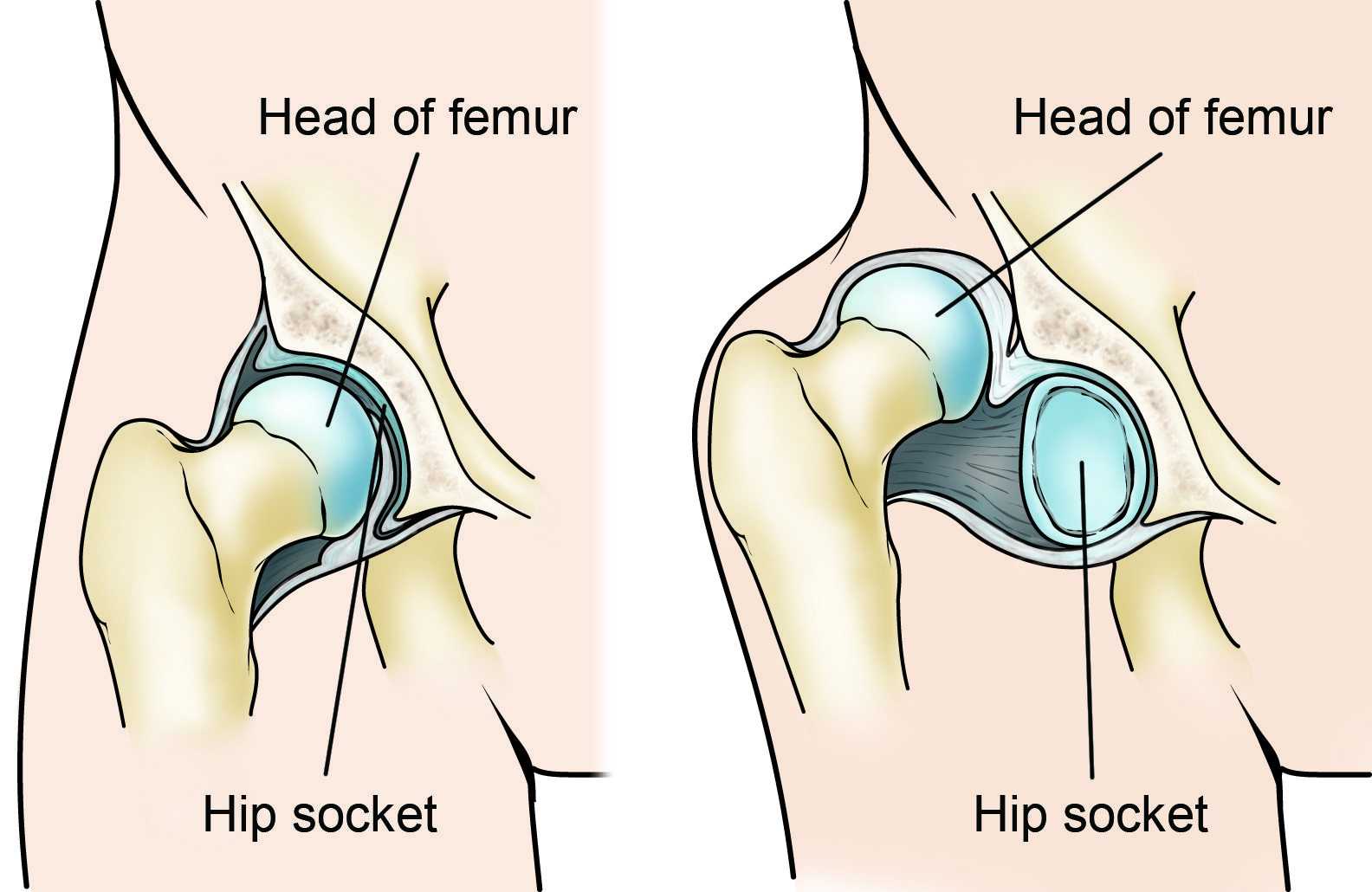
In the U.S., about 1 to 2 babies per 1,000 are born with DDH. Pediatricians screen for DDH at a newborn's first examination and at every well-baby checkup after that.
Risk Factors for DDH
DDH tends to run in families. It usually affects the left hip but can be present in either hip. It is more common in:
- Girls
- Firstborn children
- Babies born in the breech position (especially with feet up by the shoulders). The American Academy of Pediatrics now recommends ultrasound DDH screening of all breech babies.
- Family history of DDH (parents or siblings)
- Oligohydramnios (low levels of amniotic fluid)
Symptoms of DDH
Some babies born with a dislocated hip will show no outward signs.
Contact your pediatrician if your baby has:
- Legs of different lengths
- Uneven skin folds on the thigh
- Less mobility or flexibility on one side
- Limping, toe walking, or a waddling gait
Diagnosing DDH
In addition to checking for the above symptoms, your child's doctor will perform a careful physical examination to check for DDH. This includes:
- Listening and feeling for "clunks" as the hip is put in different positions
- Checking to see if the hip can be dislocated and/or put back into proper position
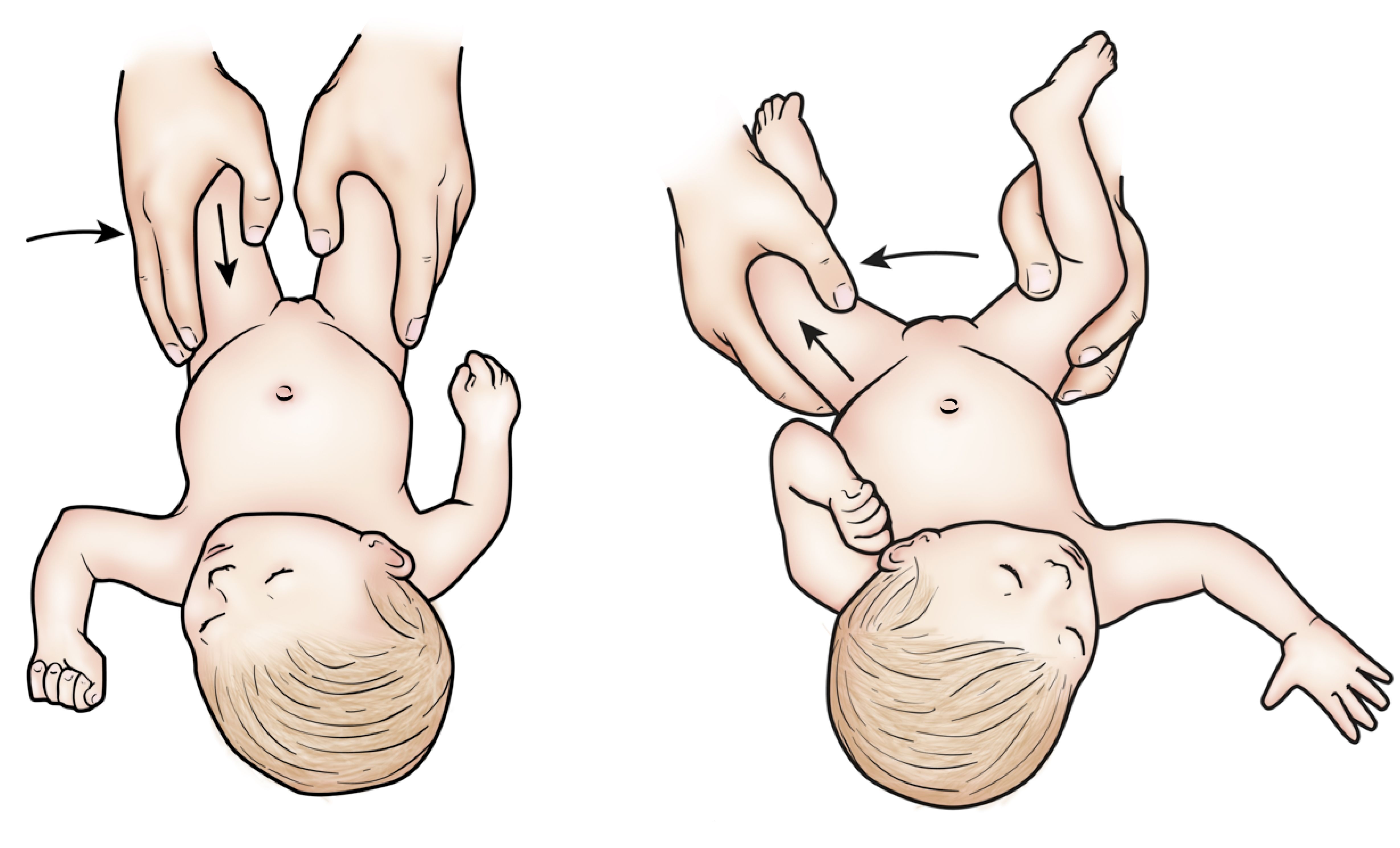
Newborns at higher risk for DDH are often tested using ultrasound. For older infants and children, X-rays of the hip may be taken to provide detailed pictures of the hip joint.
Treatment for DDH
- When DDH is found at birth, it can usually be corrected with the use of a harness or brace.
- If the hip is not dislocated at birth, the condition may not be noticed until the child begins walking. At this time, treatment is more complicated, with less predictable results.
Nonsurgical Treatment
Treatment methods depend on a child's age as well as the severity of the DDH.
Newborns. The baby may be placed in a soft brace, called a Pavlik harness, for 1 to 3 months to keep the ball in the socket. The Pavlik harness helps tighten the ligaments around the hip joint and promotes normal hip socket formation. It holds the hip in the proper position while allowing free movement of the legs and easy diaper care.
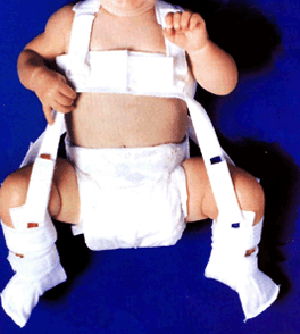
Parents play an essential role in ensuring the harness is effective. Your doctor and healthcare team will teach you how to safely diaper, bathe, feed, and dress your baby. It is very important to attend all of your baby's scheduled clinic visits so the doctor can check the hip and the fit of the Pavlik harness.
1 month to 6 months. As in newborn treatment, the ball of the hip joint is guided into the socket using a harness or similar device. This method is usually successful, even with hips that are initially dislocated.
How long the baby will require the harness varies. It is usually worn full-time for at least 6 weeks, and then part-time for an additional 6 weeks.
If the hip will not stay in position using a harness, your child's doctor may try another brace made of firmer material.
In some cases, a closed reduction procedure is required. Your child's doctor will gently move your baby's thighbone into the proper position, then apply a body cast (spica cast) to hold the bones in place. This procedure is done while the baby is under anesthesia.
Caring for a baby in a spica cast requires specific instruction. Your child's doctor and healthcare team will teach you how to care for the baby in the cast.
6 months to 2 years. Older babies may also be treated with closed reduction and spica casting. Sometimes, they will need more surgery.
Surgical Treatment
6 months to 2 years. If a closed reduction is not successful at putting the thighbone in its proper position, open surgery is necessary. An incision is made at the baby's hip that allows the surgeon to clearly see the bones and soft tissues.
In some cases, the thighbone will be shortened to properly fit the bone into the socket. X-rays are taken during the operation to confirm that the bones are in the right place. Afterward, the child is placed in a spica cast for about 3 months.
Older than 2 years. Surgery is typically necessary to realign the hip. A spica cast is usually applied to maintain the hip in the socket.
Recovery from DDH Treatment
In many children with DDH, a body cast or brace is required to keep the hip bone in the socket during healing. The cast may be needed for up to 3 months. Your child's doctor may change the cast during this time period.
X-rays and other regular follow-up monitoring are needed after DDH treatment.
Potential Complications of DDH Treatment
- Children treated with spica casting may have a delay in walking. However, after the cast is removed, walking development proceeds normally.
- The Pavlik harness and braces may cause skin irritation around the straps. Rarely, positioning in the Pavlik harness may cause nerve compression in the leg, with loss of motion. The nerve recovers if the harness is removed or adjusted.
- Growth problems of the upper thighbone can happen. Sometimes, the blood supply to the hip is disrupted.
- Even after treatment, your child may still have a shallow hip socket. Surgery may be necessary in early childhood to restore the normal anatomy of the hip joint.
Outcomes of DDH Treatment
If diagnosed early and treated successfully, children are able to develop a normal hip joint. They should be able to do normal things.
Left untreated, DDH can lead to pain and arthritis by early adulthood. It may produce a difference in leg length or decreased agility.
Even with treatment, hip deformity and arthritis may develop later in life. This is especially true when treatment begins after 2 years of age.
To assist doctors in the management of pediatric developmental dysplasia of the hip, the American Academy of Orthopaedic Surgeons has conducted research to provide some useful guidelines. These are recommendations only and may not apply to every case. For more information: Plain Language Summary - Clinical Practice Guideline - Developmental Dysplasia of the Hip - AAOS

Peer-Reviewed by
AAOS does not endorse any treatments, procedures, products, or physicians referenced herein. This information is provided as an educational service and is not intended to serve as medical advice. Anyone seeking specific orthopaedic advice or assistance should consult his or her orthopaedic surgeon, or locate one in your area through the AAOS Find an Orthopaedist program on this website.